


Two Shots A Year Could Change HIV Prevention Forever
By Parthasarathe Jayashanker
Edited by Koh Hai Yi
What if one of medicine’s longest battles could be challenged with just two injections a year? After more four decades, HIV has been among the most challenging issues for global public health care providers. Modern antiretroviral drugs have turned the diagnosis of HIV into a chronic condition, but preventive measures cannot be underestimated. A breakthrough in science occurred in 2025 when Yeztugo (lenacapavir) was approved by the United States Food and Drug Administration (U.S. FDA) as the first injection-based pre-exposure prophylaxis (PrEP) to prevent the infection that had to be administered only twice a year.
Figure 1: Yeztugo (lenacapavir) packaging and single-dose vial

What Is Lenacapavir?
Lenacapavir is a capsid inhibitor, a newer class of HIV medication. The HIV virus keeps its genetic code in a protein coat known as capsid. Lenacapavir is an antiretroviral that blocks this protein coat and inhibits several processes in the life cycle of the HIV virus. This new drug provides a novel approach to treating HIV, since it attacks a completely new mechanism compared to other HIV medications. This represents an important innovation in HIV medicine.
For HIV prevention, lenacapavir is administered as an injection once every six months. This is unlike the regular oral methods of PrEP that comes in the form of daily intake of pills.
Figure 2: Multi-Stage Inhibition of the HIV Life Cycle
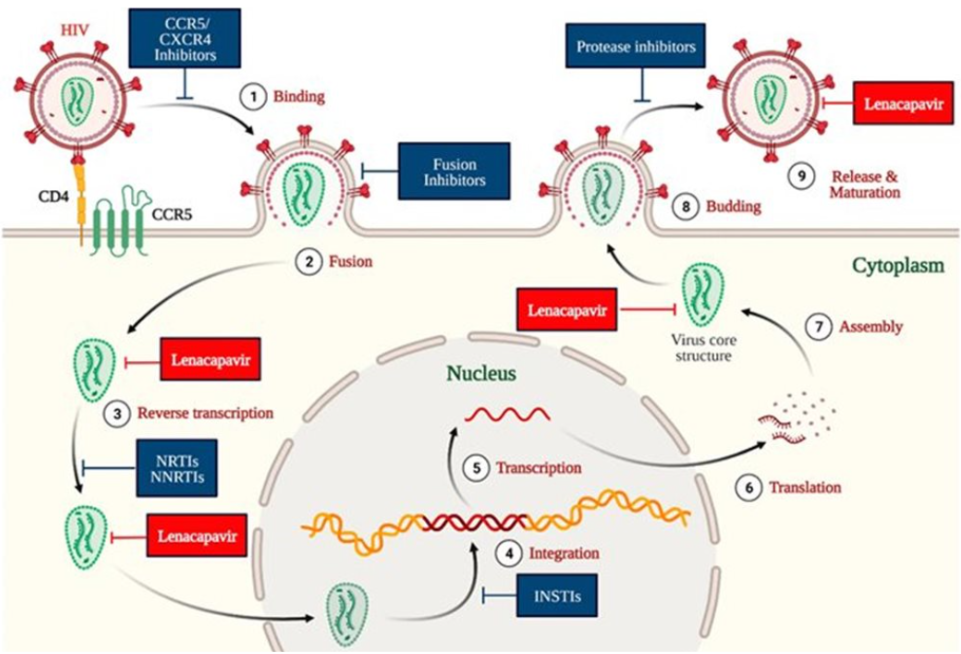
Source: Dzinamarira T., et al./Medicina, 2023
Why Does It Matter So Much?
The daily oral PrEP drugs like Truvada and Descovy have proved to be very effective. However, real-world prevention often faces obstacles including:
missed doses;
inconvenience of daily medication;
stigma around HIV prevention;
difficulty accessing clinics or prescriptions;
lower uptake among vulnerable communities.
A twice-yearly injection may help overcome many of these barriers by reducing how often patients need to think about HIV prevention.
Figure 3: Overcoming Barriers to Care

Source: The Borneo Post
The Clinical Trial Results
Lenacapavir gained global attention after the PURPOSE clinical train programme.
In PURPOSE 1, involving cisgender women in South Africa and Uganda, no HIV infections were observed among participants who received lenacapavir during the trial period, demonstrating exceptionally strong preventive efficacy.
In PURPOSE 2, involving cisgender men, transgender men, transgender women and non-binary participants across several countries, lenacapavir was also shown to significantly reduce HIV infections compared with background incidence rates and comparator groups.
These studies established lenacapavir as one of the most promising PrEP innovations to date.
FDA Approval & Rolling Out
The FDA approved lenacapavir for PrEP under the brand name of “Yeztugo”. It is the first drug that can prevent HIV infection by conferring protection for six months after a single dose.
Since approval, health organizations and insurance companies have started adding this drug to their formularies.
The Biggest Challenge Now: ACCESS
The scientific question, “does it work?”, has largely been answered. The more urgent question is now: “who will be able to get it?”.
Globally, HIV disproportionately affects low-income regions and marginalized populations. Many of the communities that could benefit most from long-acting PrEP face structural barriers such as:
high medication costs;
limited healthcare infrastructure;
shortages of trained providers;
inconsistent HIV screening access;
social stigma and discrimination.
International organizations have been expanding plans to improve global access to lenacapavir, but equitable rollout remains one of the defining public health challenges ahead.
In Malaysia, besides the importance of lenacapavir from a clinical point of view, the drug may be useful because of how it fits into an emerging national HIV prevention framework. Specifically, the National Guideline on HIV PrEP Programme Implementation 2025 has been issued by the Ministry of Health, indicating a greater push for PrEP within the national HIV agenda. Nonetheless, there are barriers including the fact that PrEP use has been traditionally low, and certain key groups still bear the brunt of new HIV cases.
A recent Malaysian research published in 2026 found that many sexual and gender-diverse individuals were open to using newer forms of PrEP, including the 6-monthly injections. This is important because it implies that lenacapavir may be particularly pertinent among people who have difficulty adhering to the daily oral dose regimen, due to various reasons, such as confidentiality issues and stigma. Overall, lenacapavir could lead to impactful outcomes if introduced affordably through public-private partnerships or future government programmes.
Is This the End of HIV?
Not yet.
Lenacapavir is not a cure for HIV, and it does not eliminate the virus in people already living with HIV. It also does not replace condoms for protection against other sexually transmitted infections.
However, if widely adopted among populations at highest risk, long-acting PrEP could substantially reduce new HIV transmissions over time. In that sense, lenacapavir may become one of the most important tools yet in turning the tide against the epidemic.
Figure 4: Comprehensive HIV Prevention Strategies

Source: Thomson Medical (2025)
Final Thoughts
For decades, HIV prevention has depended heavily on daily adherence, regular access to healthcare, and overcoming stigma. Lenacapavir changes that equation by reducing prevention to just two injections a year.
The breakthrough has already happened in the laboratory and in clinical trials. What comes next will determine its true legacy: whether the world can ensure that this innovation reaches the people who need it most.
Written by,
Parthasarathe Jayshanker.
References
Aidsmap.com(2025). Lenacapavir plus broadly neutralising antibodies could be twice-yearly HIV treatment. https://www.aidsmap.com/news/mar-2025/lenacapavir-plus-broadly-neutralising-antibodies-could-be-twice-yearly-hiv-treatment
American Association for the Advancement of Science (AAAS)(2025). The Road to Lenacapavir, a Breakthrough HIV Treatment. https://www.aaas.org/news/road-lenacapavir-breakthrough-hiv-treatment
American Society for Microbiology (ASM) (2025). How HIV Capsid Research Sparked a New Era in Prevention. https://asm.org/articles/2025/december/how-hiv-capsid-research-sparked-a-new-era-in-preve
Jarvis, L. (2025, July 6). HIV scientific drug lenacapavir breakthrough isn’t enough. Bloomberg. https://www.bloomberg.com/opinion/articles/2025-07-06/hiv-scientific-drug-lenacapavir-breakthrough-isn-t-enough
Chong, N., et al. (2026). Preferences for emerging modalities of HIV PrEP among sexual and gender diverse populations in Malaysia. Sexual Health Journal. https://doi.org/10.1071/SH25092
Clinicalinfo.hiv.gov (2024). Lenacapavir: Patient Information (NIH). https://clinicalinfo.hiv.gov/en/drugs/lenacapavir/patient
Gilead Sciences (2025). Yeztugo (lenacapavir) is now the first and only FDA-approved HIV prevention option offering 6 months of protection. https://www.gilead.com/news/news-details/2025/yeztugo-lenacapavir-is-now-the-first-and-only-fda-approved-hiv-prevention-option-offering-6-months-of-protection
Ministry of Health Malaysia (2025). National Guideline on HIV PrEP Programme Implementation in Malaysia 2025. https://www.moh.gov.my/en/publications-and-reports/policies-act-policies-guide-lines/garis-panduan-umum-kkm/senarai-garis-panduan-umum-awam/national-guideline-on-hiv-prep-programme-implementation-in-malaysia-2025
NPR(2024). This drug is the ‘breakthrough of the year’ — and it could mean the end of the HIV epidemic. https://www.npr.org/sections/goats-and-soda/2024/12/12/g-s1-37662/breakthrough-hiv-lenacapavir
Reuters(2026). Global Fund Expands commitment to improve access to HIV drug. https://www.reuters.com/business/healthcare-pharmaceuticals/global-fund-expands-commitment-improve-access-hiv-drug-2026-04-14/
Thomson Medical (2025). How to Prevent HIV. https://www.thomsonmedical.com/blog/how-to-prevent-hiv



A friend shared a link to this scratch planet clicker-style game while we were talking about old Scratch projects, and I ended up trying the browser version instead. The interface is fairly clean, everything is separated well enough that nothing feels confusing. Tested it on an older laptop and it still ran fine, no crashes or noticeable slowdown.